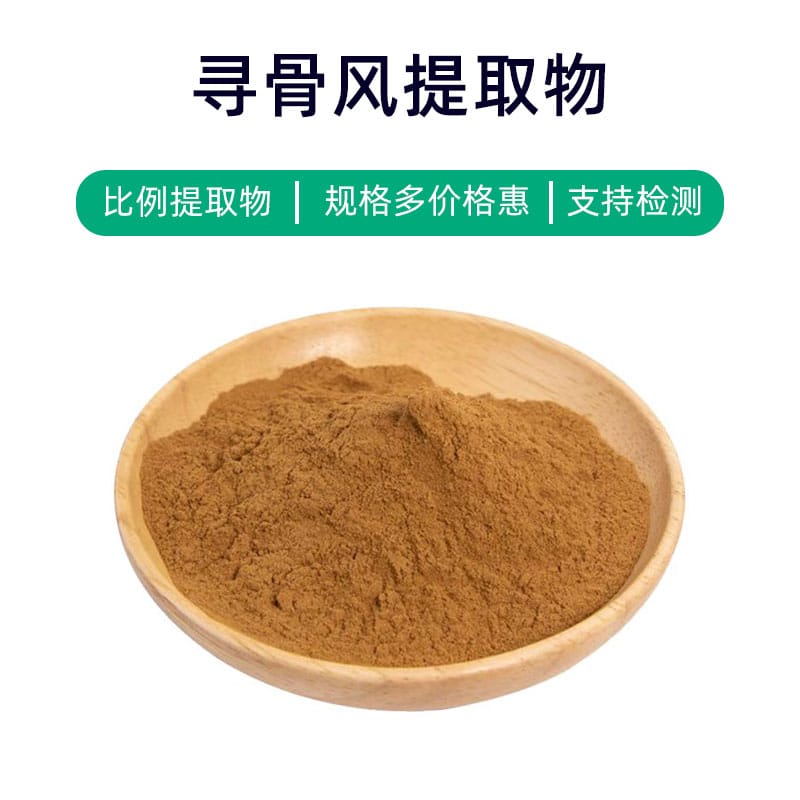



Xunbu Feng Extract Product Introduction
Xunbu Feng extract is a natural medicinal material extracted from the roots of Xunbu Feng (Radix Dipsaci). Its main components include active substances such as phenolic compounds, flavonoids, and polysaccharides. It is widely used in traditional Chinese medicine for treating and preventing bone diseases.
Xunbu Feng extract is believed to have benefits such as strengthening bones, nourishing the liver and kidneys, and promoting blood circulation while relieving pain. The active components it contains can support the growth and development of the skeletal system, enhance bone density, and prevent or alleviate conditions like osteoporosis and osteoarthritis. Additionally, it may improve joint flexibility, reduce joint pain, and promote soft tissue repair.
In the pharmaceutical field, Xunbu Feng extract is commonly used in traditional Chinese medicine formulations for conditions like osteoporosis. In the health product sector, it is often used as an ingredient for supplements in forms like tablets and capsules. Furthermore, Xunbu Feng extract can also be incorporated into cosmetics for skincare products, offering moisturizing and antioxidant benefits.
Overall, Xunbu Feng extract is regarded as a rich natural medicinal resource with various beneficial effects widely applied in traditional Chinese medicine, health products, and cosmetics, aiding in health and beauty.
Xunbu Feng Extract Production Process
The production process of Xunbu Feng extract typically includes the following key steps:
- Raw Material Collection and Preparation: High-quality Xunbu Feng roots are selected as raw materials. After collection, the materials are washed and chopped to facilitate the extraction process.
- Extraction Process: This is the crucial step for extracting active components from Xunbu Feng. Common extraction methods include water extraction and alcohol extraction. Water extraction is frequently used, involving soaking or boiling to dissolve the active ingredients in water.
- Concentration and Drying: The resultant liquid extract is concentrated to remove excess moisture and increase the concentration of active components. The concentrated liquid is then dried, usually by spray drying or vacuum drying, to produce a powdered extract.
- Milling and Screening: The dried extract is milled and screened to ensure uniformity and consistency in particle size.
- Quality Control: Stringent quality control measures are implemented throughout production, including raw material quality checks, monitoring and controlling the production process, and analyzing product composition for quality assessment.
- Packaging and Storage: Finally, the extract is packaged, usually in sealed containers to protect against moisture and light. After packaging, the extract should be stored in a cool, dry, and well-ventilated place, away from high temperatures, humidity, and direct sunlight to ensure quality and stability.
These steps outline the typical production process for Xunbu Feng extract, with each step requiring strict control to guarantee product quality and safety.
Xunbu Feng Extract Effects and Side Effects
Xunbu Feng (Scientific name: Clematis chinensis Osbeck) is a common medicinal herb with various effects in traditional Chinese medicine. Below are the primary benefits and effects of Xunbu Feng extract:
- Anti-inflammatory Effects: The extract contains various active components that exhibit anti-inflammatory properties, useful for treating arthritis and rheumatic diseases.
- Pain Relief: Xunbu Feng extract may relieve pain, including headaches and muscle pain.
- Improving Blood Circulation: It can enhance blood circulation and improve microcirculation, helping alleviate conditions caused by poor blood flow.
- Muscle Relaxation: The extract has muscle-relaxing properties, useful for treating sports injuries, strains, and fractures, aiding in tissue recovery.
- Antimicrobial and Anti-inflammatory: The extract has natural antimicrobial properties that can inhibit the growth of bacteria and fungi, aiding in the treatment of skin infections and ulcers.
- Immune Regulation: It may help enhance the immune system, boosting resistance to diseases.
- Antioxidant: Rich in antioxidants, the extract can neutralize free radicals, slow down cellular aging, and provide protective benefits for cardiovascular health and cancer prevention.
- Sleep Improvement: It has calming properties that can alleviate anxiety and insomnia, helping improve sleep quality.
Despite its numerous benefits, Xunbu Feng extract may have potential side effects, including allergic reactions and gastrointestinal discomfort. Therefore, it is crucial to assess individual conditions before use to avoid unnecessary risks. Additionally, long-term or high-dose use may lead to adverse reactions, so it is advisable to use it under medical supervision and follow proper dosing guidelines.
Xunbu Feng Extract Application Scenarios and Dosage
Xunbu Feng extract has broad applications in the fields of medicine, food, and cosmetics. Here are its application scenarios and dosage recommendations in various sectors:
- Pharmaceutical Field:
- Arthritis and Rheumatoid Arthritis Treatment: Xunbu Feng extract can be formulated into topical patches or ointments applied to affected areas 1-2 times daily, massaging gently until absorbed.
- Fracture and Sports Injury Recovery: It can be made into medicinal wine or ointments for external application, accompanied by gentle massage to promote circulation, used 2-3 times daily.
- Skin Infections and Ulcers Treatment: Xunbu Feng extract can be prepared as an external ointment or solution, applied to affected areas 2-3 times daily until healed.
- Food Industry:
- Flavoring Agents and Medicinal Foods: Xunbu Feng extract may serve as a food additive for seasoning or making health products, generally used at a dosage of 0.1-0.5 grams per 100 grams of food.
- Cosmetics Sector:
- Skincare Formulations: The extract's abundant active components can be used in skincare products, providing antioxidant, anti-inflammatory, and antimicrobial effects, typically added at 0.5-5% of the product's total weight.
- Hair Care Products: Incorporating Xunbu Feng extract in shampoos and conditioners can enhance their efficacy, reducing dandruff and alleviating itching, with usage at 1-5% of the total product weight.
- Usage and Dosage Considerations:
- Always read product instructions carefully before use.
- For external applications, clean the area first, then apply an appropriate amount of the extract, gently massaging until absorbed.
- Dosages may need adjustment based on patient age and severity of condition, so consultation with a healthcare provider is recommended.
- Discontinue use and seek medical advice if any allergic reactions or discomfort occur.
In summary, Xunbu Feng extract offers diverse applications across medicine, food, and cosmetics, but it is important to select suitable products and dosages based on specific circumstances, while remaining mindful of potential adverse reactions.
Xunbu Feng Source Plant Introduction, Distribution, and Growth Environment
Xunbu Feng (Scientific name: Caulis Spatholobi), also known as Southern Bone, Southern Wintergreen, and Stone Blood Vine, is a common medicinal herb whose extracts are often used in pharmaceuticals and health products. Here’s a detailed introduction regarding the source plant, distribution, and growth environment of Xunbu Feng:
- Source Plant Overview:
Xunbu Feng is a perennial woody vine belonging to the legume family. The primary part used is the stem, which grows in a creeping or climbing manner, demonstrating vigorous growth. The plant typically reaches heights of 3 to 6.5 feet, with a round stem surface featuring vertical lenticels. - Distribution:
Xunbu Feng is widely distributed in the southern and central regions of China, mainly thriving in mountainous and hilly areas of subtropical and temperate regions at altitudes between 656 to 4,921 feet. Its primary distribution is found in Jiangxi, Hunan, Guangdong, Guangxi, Fujian, Hubei, and Zhejiang, with particularly high yields in regions like Hunan, Jiangxi, and Guangdong. - Growth Environment:
Xunbu Feng prefers warm and humid conditions, requiring ample sunlight and favoring well-ventilated, sunny environments. It typically grows at the edges of forests, in grassy underbrush, along streams, and in rocky crevices. While it is adaptable to various soil types, it thrives best in loose, fertile, well-drained soils. - Growth Characteristics:
Xunbu Feng has rapid growth, with thin and flexible stems appearing gray or light brown. From late spring to early summer, new shoots emerge from the tops, and the stems develop a rust-colored brown bark, giving it a unique appearance. By autumn, the base of the stem starts to lignify, making older stems harder, while retaining some flexibility internally.
In conclusion, Xunbu Feng is a fast-growing woody vine with a broad distribution, mainly found in southern and central China’s mountainous and hilly regions, requiring specific conditions for temperature and sunlight, and thriving in well-lit, ventilated environments.
Processing and Storage of Xunbu Feng Extract
The processing of Xunbu Feng extract includes harvesting, drying, crushing, soaking, and extraction steps. Initially, the stems of Xunbu Feng are collected and impurities are removed, followed by drying until moisture is gone. Next, the dried stems are crushed to facilitate the extraction of active components. The crushed Xunbu Feng is then soaked for extraction, typically using water or alcohol methods. Finally, the resulting extract undergoes filtration, concentration, and drying to obtain the finished product.
For storage, Xunbu Feng extract should be kept in a cool, dry, and well-ventilated environment to avoid direct sunlight and humidity. Care should also be taken to prevent contact with strong odors or foreign substances to avoid contamination. Periodic checks on the quality and appearance of the extract should be performed during storage to ensure it meets quality standards. If not used for extended periods, it should be sealed to prolong its shelf life.

Monica Sun is a seasoned expert in the plant extraction industry with over a decade of experience in research and production. She specializes in the extraction and purification of plant active ingredients, focusing on driving innovation in natural product applications. Monica has participated in the development of multiple functional plant extracts, delivering high-value natural raw material solutions for the health food, pharmaceutical, and dietary supplement sectors.