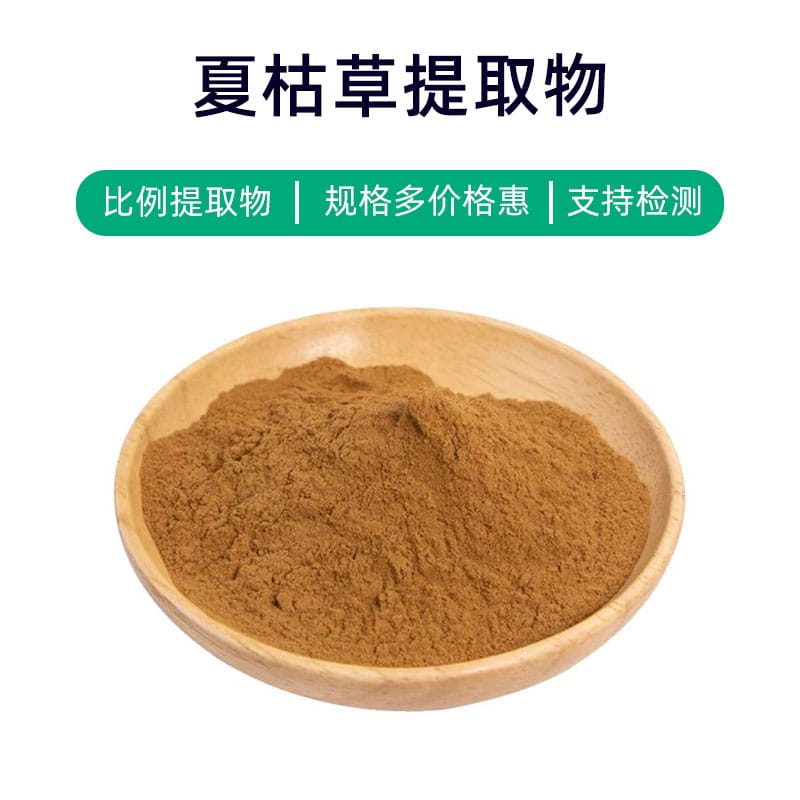



Xia Ku Cao Extract Product Introduction
Xia Ku Cao extract is a natural plant extract obtained from Xia Ku Cao (Prunella vulgaris). Its main components include various flavonoids, triterpenes, and polysaccharides. Xia Ku Cao extract is widely applied in the fields of medicine, health supplements, food, and cosmetics.
The flavonoids in the primary ingredients have antioxidant, anti-inflammatory, and antibacterial effects, helping to enhance immunity, protect cardiovascular health, and combat aging. Additionally, the triterpenes extracted from Xia Ku Cao exhibit antiviral and antitumor activity, aiding in the suppression of viral and tumor cell growth. Furthermore, polysaccharides play an important role in immune regulation and inflammation control.
In pharmaceuticals, Xia Ku Cao extract is commonly used in traditional Chinese medicine formulas, such as oral solutions and granules, for treating symptoms like wind-heat colds and sore throats. In health supplements, it is often used to produce products aimed at immune regulation, cardiovascular health, and anti-aging. In the food sector, Xia Ku Cao extract can serve as an additive in seasonings, health foods, and beverages to enhance nutritional value and functionality. In cosmetics, it is frequently included in skincare and beauty product formulations, providing moisturizing, antioxidant, and soothing properties.
Overall, Xia Ku Cao extract is a natural plant extract with extensive application prospects, providing important functional ingredients to the fields of medicine, health supplements, food, and cosmetics.
Xia Ku Cao Extract Production Process
The production process of Xia Ku Cao extract typically includes the following steps:
- Raw Material Preparation: Select high-quality Xia Ku Cao plants as raw materials, carrying out initial cleaning and impurity removal to ensure quality and purity.
- Crushing and Grinding: Crush and grind the cleaned Xia Ku Cao plants to increase extraction efficiency and surface area, using methods such as crushers and ball mills.
- Solvent Extraction: Immerse the crushed Xia Ku Cao samples in an appropriate amount of solvent (such as ethanol or water) for extraction, usually employing repeated soaking or ultrasonic extraction methods to fully dissolve the active components in the solvent.
- Filtration and Separation: Use filter paper or membrane filtration to separate solid particles and impurities from the extract, obtaining a clear extraction solution.
- Concentration and Evaporation: Employ low-temperature concentration or vacuum evaporation methods to remove the solvent from the extract solution, yielding a concentrated Xia Ku Cao extract.
- Freeze-Drying: Subject the concentrated extract solution to freeze-drying, removing moisture to obtain a dry powder of Xia Ku Cao extract.
- Crushing and Sieving: Crush and sieve the dried extract powder to ensure uniform particle size and consistency.
- Packaging and Storage: Package the finished Xia Ku Cao extract powder in sealed containers, avoiding direct sunlight and damp environments to maintain product quality and stability.
These represent the standard production process for Xia Ku Cao extract, during which strict control of parameters and operating conditions is necessary to guarantee the quality and purity of the extract.
Xia Ku Cao Extract Efficacy and Side Effects
Xia Ku Cao (scientific name: Eclipta prostrata) is a common herb widely distributed in tropical and subtropical regions worldwide. Its extract is extensively used in pharmaceuticals, health supplements, and cosmetics, possessing various effects and benefits.
- Anti-Inflammatory Effects: Xia Ku Cao extract contains abundant bioactive components, demonstrating notable anti-inflammatory effects, which can effectively relieve skin inflammation and itching.
- Antioxidant Effects: The antioxidant substances in the extract can eliminate free radicals, reduce oxidative stress, protect cells from oxidative damage, and delay aging.
- Promotes Hair Growth: Xia Ku Cao extract promotes blood circulation in the scalp, encouraging hair growth and improving hair quality.
- Prevents Hair Loss: The active components in Xia Ku Cao extract can regulate follicle function, enhance hair growth, and reduce hair loss.
- Improves Skin Issues: Xia Ku Cao extract has strong antibacterial and antiviral effects, effective for treating various skin conditions, such as acne, eczema, and herpes.
- Anti-Cancer Properties: Some studies suggest that the active components in Xia Ku Cao extract inhibit certain cancer cells, potentially helping to prevent cancer development.
- Liver Protection: Xia Ku Cao extract offers protective effects on the liver, alleviating liver damage and promoting liver cell regeneration.
- Antibacterial Effects: Xia Ku Cao extract exhibits inhibitory effects on various bacteria and fungi, useful for treating various infectious diseases.
Xia Ku Cao extract is generally safe; however, individual differences and allergic reactions may lead to some side effects such as skin allergies or digestive issues. Therefore, skin sensitivity testing is recommended before use, and users should avoid excessive consumption to prevent adverse reactions.
In summary, Xia Ku Cao extract has multiple effects and benefits, making it widely applicable in the fields of medicine, health supplements, and cosmetics. Caution should be exercised regarding dosage and individual differences to ensure safety and effectiveness.
Xia Ku Cao Extract Application Scenarios and Dosage
Xia Ku Cao extract has extensive applications across the fields of medicine, food, and cosmetics, with its dosing varying by application scenario.
- Medical Applications:
- Xia Ku Cao extract is often utilized in traditional medicine formulations to treat various skin conditions, such as eczema, ulcers, and itching. It can be used as an external ointment, wash, or infusion.
- For hair-related problems, it can be used to address hair loss and dandruff, commonly added to shampoos or scalp massage oils for daily use.
- Food Applications:
- Xia Ku Cao extract has medicinal value and can be used in health foods, such as nutritional tablets and capsules. It’s generally recommended to follow the dosage instructions provided in product specifications to maintain health.
- In traditional foods, Xia Ku Cao extract can also be used as a medicinal ingredient, such as in Xia Ku Cao tea or soup, promoting health.
- Cosmetic Applications:
- Xia Ku Cao extract is common in skincare products for conditioning the skin and improving skin issues. It may be included in serums, masks, and lotions for benefits such as skincare, whitening, and moisturizing.
- Typically, the concentration of Xia Ku Cao extract in cosmetics is low, and it should be used according to product instructions to avoid overuse.
Overall, Xia Ku Cao extract can serve as a medicinal treatment for skin issues in medical fields, as a health food component in food sectors, and as an ingredient in skincare products in cosmetics. Caution regarding product instructions is advised to avoid excessive use and potential side effects.
Xia Ku Cao Plant Source Introduction, Distribution, and Growing Environment
Xia Ku Cao (scientific name: Eclipta prostrata), also known as false ginseng, curcuma, autumn crocus, and spoon-leaf white duckweed, is a common herb belonging to the Asteraceae family. Below are the plant characteristics, distribution, and growth environment of Xia Ku Cao.
Plant Characteristics:
Xia Ku Cao is an annual herb, growing about 20-50 cm tall. The leaves are opposite, elongated oval or obovate, with a noticeable midrib and often have fine hairs on the surface. Flowers are small, forming a head-like inflorescence with yellow corollas. The fruit is a slender achene that is elongated oval and has fine white pappus. The entire plant grows prostrate, with a well-developed root system that can expand into dense grass clumps.
Distribution:
Xia Ku Cao is native to tropical and subtropical regions, widely distributed and primarily growing in southern China, the Indian subcontinent, Southeast Asia, and Africa. In China, it is mainly found in provinces south of the Yangtze River, such as Guangdong, Guangxi, Yunnan, and Fujian.
Growing Environment:
Xia Ku Cao has strong adaptability and thrives in warm, humid environments, typically found in low-altitude mountainous areas, fields, roadside areas, grasslands, and along water bodies. It is adaptable to various soil types, flourishing in fertile riverbank soil, moist clay, or sandy soil. While it prefers sunlight, it can tolerate some shade, often seen in open areas like fields, pond edges, riverbanks, and roadsides.
In summary, Xia Ku Cao is a highly adaptable and widely distributed herb that grows vigorously in warm, humid environments, particularly common in southern China, where it is often used as a medicinal and ornamental plant.
Xia Ku Cao Extract Processing and Storage
The processing of Xia Ku Cao extract typically includes the following steps: First, fresh Xia Ku Cao plants are harvested, then cleaned and processed to remove impurities. The cleaned plants undergo initial processing and grinding, followed by extraction, filtration, concentration, and drying, resulting in Xia Ku Cao extract. During processing, it is crucial to control temperature, humidity, and processing time strictly to ensure product quality and stability.
For storage, it is generally recommended to keep Xia Ku Cao extract in a dry, cool, and ventilated environment, avoiding direct sunlight and moisture. Additionally, measures should be taken to prevent the extract from being affected by oxygen, light, heat, and moisture. Sealing in containers or aluminum foil bags can help extend shelf life and stability. The extract should be periodically checked for any unusual odors, mold, or other abnormalities during storage to ensure its quality.

Monica Sun is a seasoned expert in the plant extraction industry with over a decade of experience in research and production. She specializes in the extraction and purification of plant active ingredients, focusing on driving innovation in natural product applications. Monica has participated in the development of multiple functional plant extracts, delivering high-value natural raw material solutions for the health food, pharmaceutical, and dietary supplement sectors.