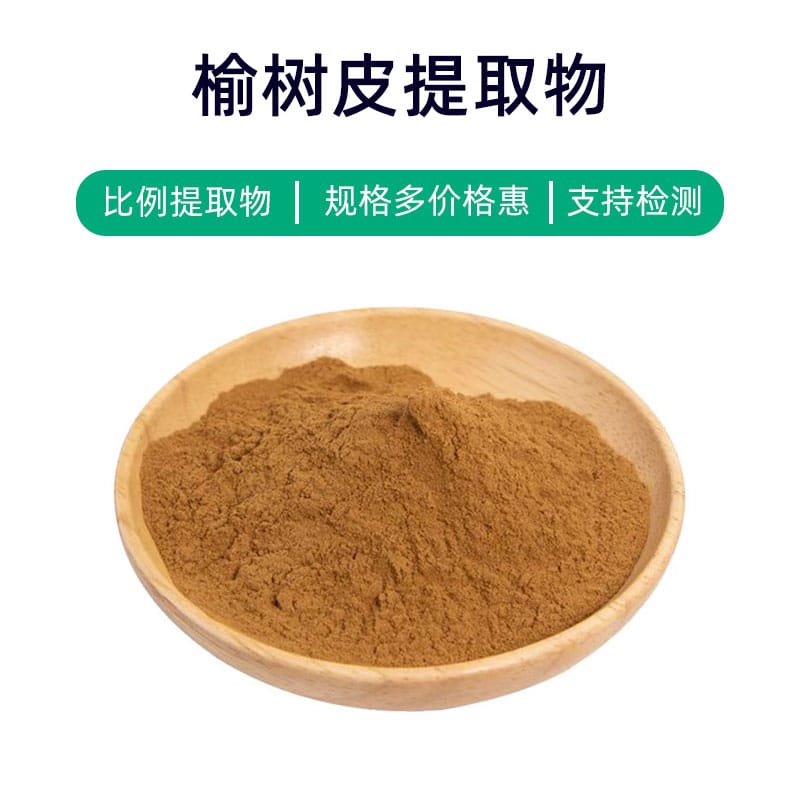



Elm Bark Extract Product Description
Elm bark extract is a natural plant extract obtained from the bark of the elm tree (Ulmus spp.), containing abundant phenolic compounds, polyphenols, flavonoids, and vitamins. These components give elm bark extract a variety of benefits and applications.
Firstly, elm bark extract exhibits significant antioxidant properties, capable of neutralizing free radicals, delaying aging, and protecting cells from oxidative damage. Additionally, it also possesses anti-inflammatory and antibacterial effects, helping to alleviate inflammatory responses, reduce skin discomfort, and inhibit bacterial growth.
In terms of applications, elm bark extract is widely used in pharmaceuticals, health supplements, and cosmetics. In pharmaceuticals, it is commonly used in traditional herbal formulations to modulate immunity, exhibit anti-inflammatory and antibacterial effects, and address skin inflammation and infections. In health supplements, it is often added as a natural antioxidant to improve the internal environment and boost immunity. In cosmetics, elm bark extract can be found in skincare products, masks, etc., contributing to skin protection, improving skin condition, and reducing skin sensitivity.
Overall, elm bark extract is a multifunctional natural plant extract that provides various benefits such as antioxidant, anti-inflammatory, and antibacterial effects, widely applied in pharmaceuticals, health supplements, and cosmetics, offering strong support for health and beauty.
Elm Bark Extract Production Process
The production process of elm bark extract mainly includes the following steps:
- Raw Material Collection: Select high-quality elm bark as raw material, typically harvested in spring or autumn to ensure freshness and quality.
- Cleaning: Wash the collected elm bark to remove surface impurities and dirt, maintaining the purity of the raw material.
- Crushing and Grinding: Crush or grind the cleaned elm bark into a powder or granular form to increase extraction efficiency and uniformity.
- Extraction Process: Use appropriate extraction methods, commonly water extraction, ethanol extraction, or supercritical CO2 extraction. Control parameters such as temperature, time, and pressure during extraction to ensure optimal results and stability of components.
- Filtration and Concentration: Filter the extract to remove impurities and solid particles, then concentrate to reduce solvent content and increase the concentration of the extract.
- Purification: Employ purification processes to remove any potential impurities and unwanted components, enhancing product purity and quality.
- Drying: Dry the concentrated extract, typically using spray drying or vacuum drying techniques, to produce a stable powder or granular finished product.
- Packaging and Storage: Finally, package the dried elm bark extract, usually in sealed aluminum foil bags or plastic containers, to protect against moisture and light, preserving product stability and longevity.
The above outlines the conventional production process for elm bark extract, with each step requiring strict control of operational parameters and quality standards to ensure the final product's quality and efficacy meet requirements.
Elm Bark Extract Efficacy and Side Effects
Elm bark extract is a natural plant extract with multiple benefits, primarily including the following aspects:
- Antioxidant Effect: Rich in polyphenols and flavonoids, elm bark extract possesses strong antioxidant capabilities, neutralizing free radicals and slowing cellular oxidative damage, thus helping to protect cellular health and delay aging.
- Anti-Inflammatory Effect: Research indicates that the phenolic compounds in elm bark extract have anti-inflammatory properties, inhibiting inflammatory responses and alleviating pain and discomfort related to skin inflammation, arthritis, and similar conditions.
- Antibacterial Effect: Elm bark extract exhibits inhibitory effects against various bacteria, fungi, and viruses, making it useful for preventing and treating skin issues associated with bacterial infections, such as acne and herpes.
- Skin Protection: Elm bark extract also offers skin protection benefits, enhancing skin barrier function, maintaining moisture balance, and improving issues like dryness and roughness, resulting in softer, smoother skin.
- Sensitivity Improvement: For sensitive or easily irritated skin, elm bark extract provides soothing effects, reducing allergic reactions and decreasing skin sensitivity to external stimuli.
Overall, as a natural plant extract, elm bark extract has a range of benefits including antioxidant, anti-inflammatory, antibacterial, skin protective, and sensitivity improvement effects. It is suitable for various skin types and can be incorporated into skincare and health products, providing effective support for skin health and beauty. Under normal use, elm bark extract typically does not produce significant side effects. However, for special populations or those with allergies, it is advisable to conduct a skin test prior to use to avoid adverse reactions.
Elm Bark Extract Application Scenarios and Dosage
Elm bark extract is widely used in the fields of medicine, food, and cosmetics, with dosage varying slightly across these areas.
- Medical Applications:
- Anti-inflammatory and Antioxidant: Elm bark extract is commonly used to prepare topical ointments or sprays for treating mild skin inflammation, acne, etc., usually applied in appropriate amounts to the affected area 1-2 times daily.
- Antibacterial Action: It can be formulated into oral solutions, capsules, or tablets for adjunctive treatment of oral or gastrointestinal infections, with dosage determined by specific conditions and formulations.
- Anti-inflammatory Pain Relief: Elm bark extract can also be used to create anti-inflammatory pain relief patches or plasters for conditions like arthritis and strains, applied in suitable amounts to the affected area 1-2 times daily.
- Food Applications:
- Antioxidant: Elm bark extract can be used as a food additive to prevent oxidation and spoilage, improving food quality and shelf life, generally added in suitable amounts per kilogram of food, with specific quantities depending on the type of food.
- Seasoning: It can also be utilized in seasonings to enhance flavor and aroma, though the amount should be carefully controlled to avoid affecting food taste.
- Cosmetics Applications:
- Skincare Products: Elm bark extract is frequently included in skincare products like creams, lotions, and serums, providing antioxidant, moisturizing, and soothing effects, typically applied in suitable amounts to cleansed facial skin and massaged until absorbed.
- Sunscreens: Elm bark extract can also be added to sunscreens or sprays to enhance antioxidant and anti-inflammatory benefits, with dosage determined by specific product formulations, following the usage guidelines on product labels.
It is important to note that the formulations and dosages of different products may vary, and consumers should carefully read product labels or consult a doctor or professional for advice before use. Additionally, individual variability and allergic reactions should be considered; if discomfort arises, discontinue use and seek medical advice.
Elm Bark Extract Source Plant Introduction, Distribution, and Growing Environment
The primary source of elm bark extract is the elm tree (Ulmus spp.), which will be introduced here, including its botanical characteristics, distribution range, and growing environment.
The elm tree is a type of deciduous tree or shrub belonging to the Ulmaceae family, with over 40 different species worldwide. Generally, elms have a broad, umbrella-like crown, gray or gray-brown bark, and alternate single leaves. The trunks are typically straight, with smooth or textured bark, and the leaves are ovate or elliptical with finely serrated edges, generally deep green in color.
Elms are mainly distributed in temperate and subtropical regions, primarily growing in the Northern Hemisphere, including Europe, North America, and Asia. In Europe, elms are widely distributed in countries like the UK, France, and Germany. In North America, they can be found throughout Canada and the United States. In Asia, elms are primarily found in China, Japan, and Korea.
Elms prefer to grow in moist, fertile soils and require a sunny environment. They commonly grow along riverbanks, around lakes, on hills, and in valleys. Elms have strong adaptability to different soil types, thriving in sandy soils, loam, and clay. Additionally, elms can withstand cold, drought, and saline-alkaline conditions, making them suitable for various climate and soil environments.
In summary, elms are widely distributed and highly adaptable tree species, primarily found in temperate and subtropical regions with relatively lenient soil and climate requirements, making it relatively easy to find elms in these areas. This also makes elms a significant source material for elm bark extract.
Processing and Storage of Elm Bark Extract
The processing of elm bark extract primarily includes the following steps: First, collect fresh elm bark, then clean and grind it, followed by extraction using methods such as water extraction, ethanol extraction, and supercritical CO2 extraction. The resulting elm bark extract undergoes filtration, concentration, purification, and drying processes to yield the final product.
For storage, it is essential to keep the extract in a cool, dry, well-ventilated area, avoiding direct sunlight and high temperatures. Use well-sealed containers to prevent contact with air and moisture. Periodically check the extract during storage to ensure there are no off odors or signs of spoilage. Lastly, avoid contact with toxic substances during storage to ensure the quality and safety of the product.

Monica Sun is a seasoned expert in the plant extraction industry with over a decade of experience in research and production. She specializes in the extraction and purification of plant active ingredients, focusing on driving innovation in natural product applications. Monica has participated in the development of multiple functional plant extracts, delivering high-value natural raw material solutions for the health food, pharmaceutical, and dietary supplement sectors.