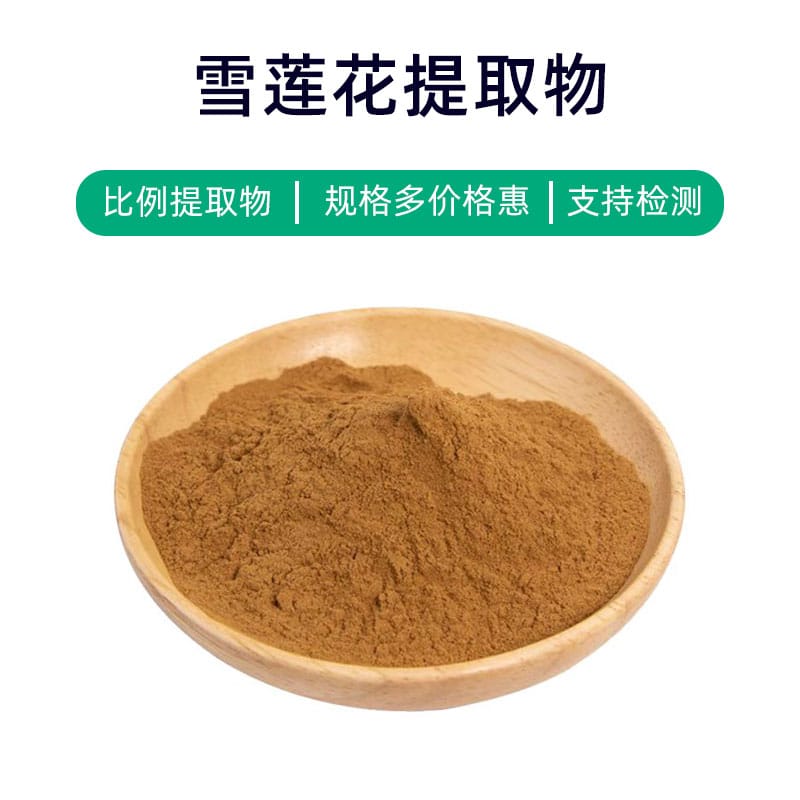



Snow Lotus Flower Extract Product Introduction
Snow Lotus Flower Extract is a natural botanical extract derived from the Snow Lotus (Saussurea involucrata), containing an abundance of active compounds such as polyphenols, flavonoids, and essential oils. These components provide Snow Lotus Flower Extract with numerous benefits and applications.
The polyphenolic compounds in the main ingredients have strong antioxidant properties, helping to neutralize free radicals, slow down the skin aging process, and enhance the skin's antioxidant capacity, resulting in healthier, more youthful skin. Meanwhile, flavonoids exhibit anti-inflammatory and soothing effects, relieving skin discomfort and reducing inflammatory responses, which helps improve sensitive skin. The essential oils contribute a unique aromatic fragrance to the extract, enhancing its application in fragrance skincare products.
Snow Lotus Flower Extract is commonly found in cosmetics, particularly in skincare products, masks, serums, etc., intended to improve the antioxidant capacity, soothe and calm the skin, enhance skin texture, and provide moisturizing effects. Its natural plant origin and gentle properties make it one of the most sought-after ingredients in many skincare products.
Snow Lotus Flower Extract Production Process
The production process of Snow Lotus Flower Extract mainly consists of the following steps:
- Raw Material Preparation: Select high-quality Snow Lotus flowers, preferably harvested when fully open, to retain maximum active compounds. After harvesting, clean and pre-treat the flowers to remove impurities and unclean parts.
- Extraction Method: Common extraction methods include water extraction, ethanol extraction, and supercritical fluid extraction. Water extraction is one of the more common methods. The cleaned Snow Lotus flowers are immersed in an appropriate amount of water or boiled to fully dissolve the active components.
- Filtration and Concentration: The extract is filtered to remove solid particles and impurities, then concentrated by evaporating the moisture to obtain the concentrated Snow Lotus Flower Extract.
- Purification of Extract: Further processing and purification techniques like gel filtration and solvent extraction enhance the purity and active compound content of the extract.
- Drying and Grinding: The purified extract undergoes drying, commonly using spray drying or vacuum drying methods. Once dried, it is ground to achieve the desired particle size.
- Packaging and Storage: Finally, the produced Snow Lotus Flower Extract is packaged and stored under appropriate conditions, protecting it from light, moisture, and high temperatures to ensure stability and retention of active ingredients.
Through these processes, high-quality Snow Lotus Flower Extract can be produced for various cosmetics, health supplements, and pharmaceuticals.
Snow Lotus Flower Extract Effects and Side Effects
As a natural plant extract, Snow Lotus Flower Extract offers several benefits and effects, primarily including:
- Antioxidant Effects: Rich in various natural antioxidants like flavonoids and polyphenols, it effectively eliminates free radicals in the body, reduces oxidative damage to cells, and protects the skin from environmental pollution and UV radiation.
- Skin Care: Snow Lotus Flower Extract provides moisturizing, nourishing, and soothing effects, helping to alleviate dry and rough skin, enhance elasticity and shine, making the skin softer and smoother.
- Anti-Inflammatory Effects: Active ingredients in the extract possess anti-inflammatory properties, reducing skin inflammation, redness, and itching, and promoting skin repair and regeneration.
- Inhibition of Dark Spots: Research indicates that certain components in the extract can inhibit melanin production, reducing the formation of dark spots and lightening existing ones, resulting in more even skin tone.
- Anti-Aging: Rich in nutrients, the extract promotes collagen synthesis, increases skin elasticity, minimizes wrinkles and fine lines, and slows down the aging process.
- Improved Skin Glow: The extract enhances blood circulation within the skin, providing better nutrient supply and improving complexion for healthier, more radiant skin.
As a natural plant extract, Snow Lotus Flower Extract typically does not cause noticeable side effects. However, individuals may experience allergic reactions; thus, it is advised to conduct a patch test prior to use. If any discomfort or allergic symptoms occur, discontinue use immediately and seek medical attention.
Applications and Dosage of Snow Lotus Flower Extract
Snow Lotus Flower Extract has extensive applications in pharmaceuticals, food, and cosmetics, with usage and dosage varying by application and specific products. Here are detailed descriptions:
- Pharmaceutical Applications:
- Used in preparing traditional Chinese medicine formulas or single agents for treating skin inflammation and allergic skin conditions.
- Usage: Can be formulated into creams, lotions, or sprays for external application, applied to affected areas 2-3 times a day as directed by a physician.
- Dosage: Typically determined based on specific conditions and patient age, generally advising moderate application, avoiding excessive use.
- Food Applications:
- Used as a food additive with health benefits, commonly found in health foods and functional beverages.
- Usage: Can be added directly as a food additive to beverages, dairy products, pastries, etc.
- Dosage: According to the product formulation and food processing requirements, typically adhering to national food safety standards for dosage control.
- Cosmetic Applications:
- Commonly utilized in cosmetics for skincare and beauty benefits, frequently found in creams, lotions, and masks.
- Usage: Evenly apply cosmetics on clean facial or body skin, gently massaging until absorbed.
- Dosage: Follow the product instructions, generally applying an appropriate amount to the skin's surface while avoiding excess use.
As a natural plant extract, Snow Lotus Flower Extract has broad application potential in pharmaceuticals, food, and cosmetics. It is recommended to purchase products from reputable sources and use them according to product instructions or medical advice to maximize benefits and minimize potential side effects.
Origin, Distribution, and Growth Environment of the Snow Lotus Flower
The Snow Lotus (scientific name: Saussurea involucrata), also known as "ice begonia" or "snow lotus," is a high-altitude plant belonging to the Asteraceae family. Here is a detailed overview of its origin, distribution, and growth environment:
- Origin:
The Snow Lotus is a perennial herb, mainly thriving in high-altitude areas, commonly found in mountain ranges such as the Himalayas, Pamirs, and Tianshan. It exhibits strong resistance and cold tolerance, able to grow and reproduce in extreme environmental conditions. - Distribution:
The Snow Lotus is primarily distributed in high-altitude regions across Asia, including China, Nepal, India, Pakistan, and Afghanistan, with the Tibetan Plateau in China being its main production area. In China, it is mainly found in high-altitude regions of Tibet, Xinjiang, and Qinghai, at elevations above 3,000 meters. - Growth Environment:
- Altitude: Snow Lotus typically grows at elevations ranging from 3,000 to over 5,000 meters, with some varieties even found at altitudes exceeding 6,000 meters.
- Climate Conditions: The growing environment is harsh, with a cold, dry climate characterized by long, severe winters and short, cool summers, ample sunlight, and sparse rainfall and snow, with drastic temperature variations.
- Soil Requirements: Snow Lotus thrives in well-drained, loose, fertile rocky or sandy loam soils. It has low pH tolerance but prefers low soil moisture and demonstrates strong drought resistance.
Overall, the Snow Lotus is a high-altitude plant that adapts to extremely harsh environmental conditions. Its distribution is primarily concentrated in Asia's mountainous areas, making it one of the precious species among alpine plants.
Processing and Storage of Snow Lotus Flower Extract
The processing of Snow Lotus Flower Extract typically involves steps such as collection, cleaning, drying, grinding, and extracting. First, fresh Snow Lotus flowers are collected, then cleaned and impurities removed. The cleaned flowers are dried to lower moisture content, usually by air drying or low-temperature drying. Next, the dried Snow Lotus flowers are ground to increase surface area for the subsequent extraction process. Lastly, appropriate extraction methods (e.g., water or ethanol extraction) are applied to extract effective components from the Snow Lotus.
For storage, Snow Lotus Flower Extract should be kept in a dry, cool, and well-ventilated environment, avoiding direct sunlight and humidity. Extracts are typically packaged in sealed containers or bags to prevent moisture and dust contamination. Additionally, contact with harmful chemicals should be avoided to ensure quality and stability. Proper storage helps extend the shelf life of Snow Lotus Flower Extract and maintains the stability of its active ingredients.

Monica Sun is a seasoned expert in the plant extraction industry with over a decade of experience in research and production. She specializes in the extraction and purification of plant active ingredients, focusing on driving innovation in natural product applications. Monica has participated in the development of multiple functional plant extracts, delivering high-value natural raw material solutions for the health food, pharmaceutical, and dietary supplement sectors.