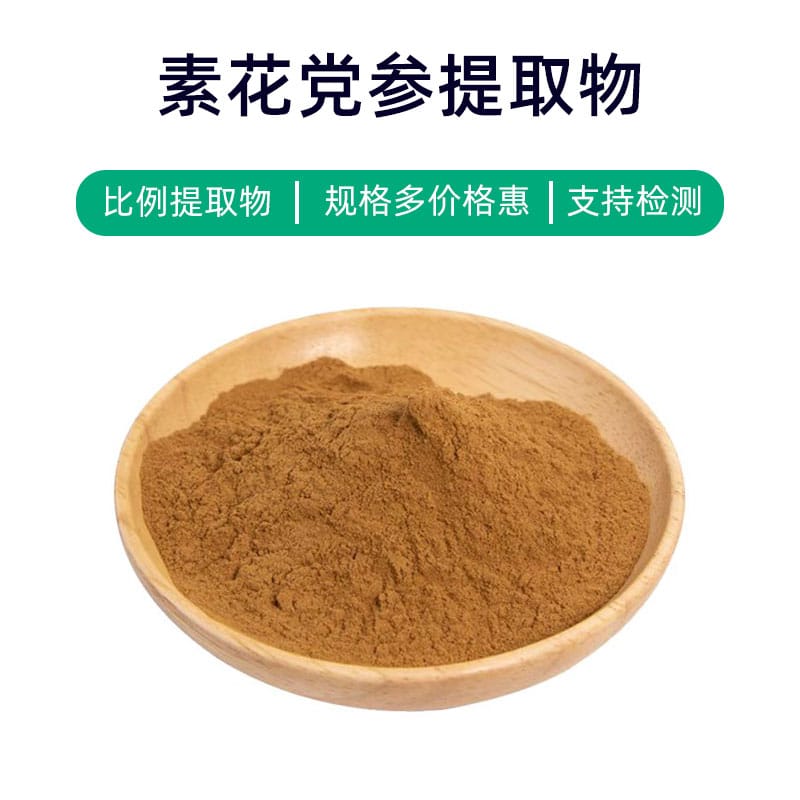



Suhua Codonopsis Extract Product Introduction
Suhua Codonopsis Extract is a natural plant extract derived from the roots of Suhua Codonopsis (Codonopsis pilosula). Its primary components include Codonopsis saponins, polysaccharides, and alkaloids, making it widely applicable in pharmaceuticals, health products, food, and cosmetics.
Firstly, the main component, Codonopsis saponins, has various health benefits, including enhancing immunity, improving physical condition, and promoting metabolism, thereby helping to boost the body's resistance and reduce the incidence of diseases.
Secondly, the polysaccharide component exhibits good bioactivity, which can regulate immune function, enhance antioxidant capacity, slow down aging, and protect the liver.
Additionally, Suhua Codonopsis Extract contains a certain amount of alkaloids, known for their calming, soothing, and sleep-improving effects, providing assistance with issues like anxiety and insomnia.
In terms of application, Suhua Codonopsis Extract is frequently used to formulate health supplements, tonics, and nutritional products aimed at improving physical condition, boosting immunity, and enhancing fatigue resistance. It can also serve as an ingredient in cosmetics, included in skincare products and masks, offering moisturizing, antioxidant, and anti-aging benefits, helping to improve skin texture and delay aging.
In summary, Suhua Codonopsis Extract is a natural plant extract with several health benefits and extensive application value, playing an important role in various fields with promising potential.
Suhua Codonopsis Extract Production Process
The production process of Suhua Codonopsis Extract generally involves the following key steps:
- Raw Material Collection and Selection: First, high-quality Suhua Codonopsis roots are collected and initially screened to remove impurities and damaged portions, ensuring quality.
- Washing and Processing: The selected roots are washed to remove surface soil and impurities, then processed, typically including slicing or chopping to increase extraction efficiency.
- Extraction: The processed roots are placed in extraction equipment with appropriate solvents (such as water or ethanol) for extraction, utilizing common methods like water or ethanol extraction. Extraction temperature and time are controlled based on different processing conditions.
- Concentration: The obtained extract is concentrated, usually through vacuum concentration or evaporation methods, removing the solvent to yield a concentrated extract.
- Filtration and Purification: The concentrated extract is filtered to remove impurities and residues, ensuring the product's purity and quality.
- Drying: The filtered extract is dried, typically using spray drying or vacuum drying methods, converting it into a powdered or granular product.
- Packaging and Storage: Finally, the dried Suhua Codonopsis Extract is packaged in sealed containers to avoid moisture and contamination, stored in a cool, dry place, away from direct sunlight and high temperatures, to ensure product quality and stability.
Through these steps, high-quality Suhua Codonopsis Extract is obtained for use in various health products, pharmaceuticals, and cosmetics.
Benefits and Side Effects of Suhua Codonopsis Extract
Suhua Codonopsis Extract is a commonly used herbal material with various benefits and effects, primarily including the following aspects:
- Anti-Fatigue Effects: Rich in active ingredients, Suhua Codonopsis Extract enhances the body's resistance to fatigue, improves antioxidant capacity, reduces fatigue, and boosts physical strength.
- Immune Regulation: The polysaccharides in Suhua Codonopsis Extract have certain affinities with the human immune system, regulating immune function, enhancing immunity, and increasing resistance to diseases.
- Antioxidant Properties: This extract is rich in antioxidants, such as polyphenols and flavonoids, which help clear free radicals and slow down aging, contributing to overall health maintenance.
- Anti-Inflammatory Effects: Some active components of Suhua Codonopsis Extract exhibit anti-inflammatory properties, helping to suppress inflammation and potentially providing therapeutic effects for inflammatory diseases.
- Blood Sugar and Lipid Regulation: Studies show that Suhua Codonopsis Extract can regulate blood glucose and lipid levels, lowering the risk of chronic diseases like diabetes and high cholesterol.
- Improving Sleep Quality: Some components in the extract have calming properties that help alleviate anxiety and insomnia, thereby enhancing sleep quality and overall vitality.
- Digestive Promotion: Certain components in the extract can stimulate digestion, promote gastric secretion, and improve gastrointestinal function, aiding in digestion and absorption.
While Suhua Codonopsis Extract offers many benefits, individual differences and moderation should be observed to avoid potential side effects from excessive use. Pregnant women, children, the elderly, and individuals with specific medical conditions should consult a doctor before using it to mitigate unnecessary risks.
Applications and Dosages of Suhua Codonopsis Extract
Suhua Codonopsis Extract has extensive applications in the fields of medicine, food, and cosmetics. Below are the primary applications, usage methods, and dosages in these areas.
- Medicine:
Suhua Codonopsis Extract, as a traditional herbal material, is commonly used in the pharmaceutical industry for drug formulation and health product production. Its primary benefits include boosting immunity, regulating blood sugar, improving sleep, and providing antioxidant effects. Typically, it is taken orally, with recommendations for adults to consume 3-5 grams per dose, 2-3 times daily; children's dosage should be halved. Specific dosages should be determined based on individual circumstances and physician advice. - Food:
Suhua Codonopsis Extract is often utilized in the food industry as a natural health food additive. It can be incorporated into seasonings, functional foods, and health supplements. The application forms in food are diverse, either added directly as an ingredient or used as a main component in supplements. Usage is typically small, adhering to food additive regulations, usually around 1-5 grams per 1000 grams of food. - Cosmetics:
In cosmetics, Suhua Codonopsis Extract is commonly included in skincare products and beauty formulations. Its antioxidant, moisturizing, and anti-inflammatory properties can improve skin texture and delay aging. The application forms in cosmetics are varied, able to be directly added as an ingredient or utilized for its active components in formulations. Usage is generally small and should follow specific product formulation guidelines, adjusted based on product type.
In summary, Suhua Codonopsis Extract serves as a natural plant extract with broad application potential in medicine, food, and cosmetics. Selection of appropriate product types and dosages should be tailored to specific situations while adhering to relevant regulations and standards.
Source Plant Introduction: Distribution and Growing Environment of Suhua Codonopsis
Suhua Codonopsis (scientific name: Radix Ophiopogonis) is a perennial herb belonging to the lily family. Below are details on the source plant, its distribution, and growing environment.
- Source Plant:
Suhua Codonopsis is a common herb with its main part being the underground tuber. The tuber is oval-shaped, with longitudinal wrinkles on the surface, thick texture, and white cross-section. The above-ground plant is generally low in height, with linear or strap-like, glossy leaves clustered at the ground. The flowering period is typically in summer, with flowers forming umbels that are small and white. - Distribution:
Suhua Codonopsis is native to China and has a widespread distribution, primarily found in North China, Northeast China, East China, Central China, and South China. Under natural conditions, it typically grows in shaded areas, on hillsides, in grasslands, and along field edges. In warmer, moist regions, Suhua Codonopsis is also frequently found in moist environments along field and water edges. - Growing Environment:
Suhua Codonopsis does not have stringent requirements for its growing environment and is highly adaptable. It prefers a warm and humid climate and is not particular about soil, often thriving in fertile, loose, well-drained soils. In natural conditions, it commonly grows in mountainous areas, forest edges, and grasslands, as well as on field edges, roadsides, and in grassy thickets. Ideally, the growing environment should have plenty of light and avoid prolonged exposure to dark, damp conditions.
In summary, Suhua Codonopsis is a well-known herb with a broad distribution primarily across various regions in China, thriving in mountainous, forested, and field environments. Its growing requirements are not strict, showing strong adaptability, and it is typically found in warm, humid, and well-lit environments.
Processing and Storage of Suhua Codonopsis Extract
The processing of Suhua Codonopsis Extract mainly involves selecting raw materials, washing, crushing, extracting, filtering, concentrating, and drying. First, fresh Suhua Codonopsis tubers are chosen, and impurities are washed away. The cleaned tubers are then crushed or sliced to enhance extraction efficiency. During extraction, suitable solvents are used for soaking or leaching to obtain the extract, which is then filtered to remove impurities before concentration and drying, ultimately yielding Suhua Codonopsis Extract.
For storage, Suhua Codonopsis Extract should be kept in a dry, cool, well-ventilated area, protecting it from direct sunlight and high temperatures. Care should be taken to prevent moisture and deterioration. It should be stored in sealed containers to shield from air and humidity. Proper storage can extend the shelf life of Suhua Codonopsis Extract and maintain the stability of its active components.

Monica Sun is a seasoned expert in the plant extraction industry with over a decade of experience in research and production. She specializes in the extraction and purification of plant active ingredients, focusing on driving innovation in natural product applications. Monica has participated in the development of multiple functional plant extracts, delivering high-value natural raw material solutions for the health food, pharmaceutical, and dietary supplement sectors.